


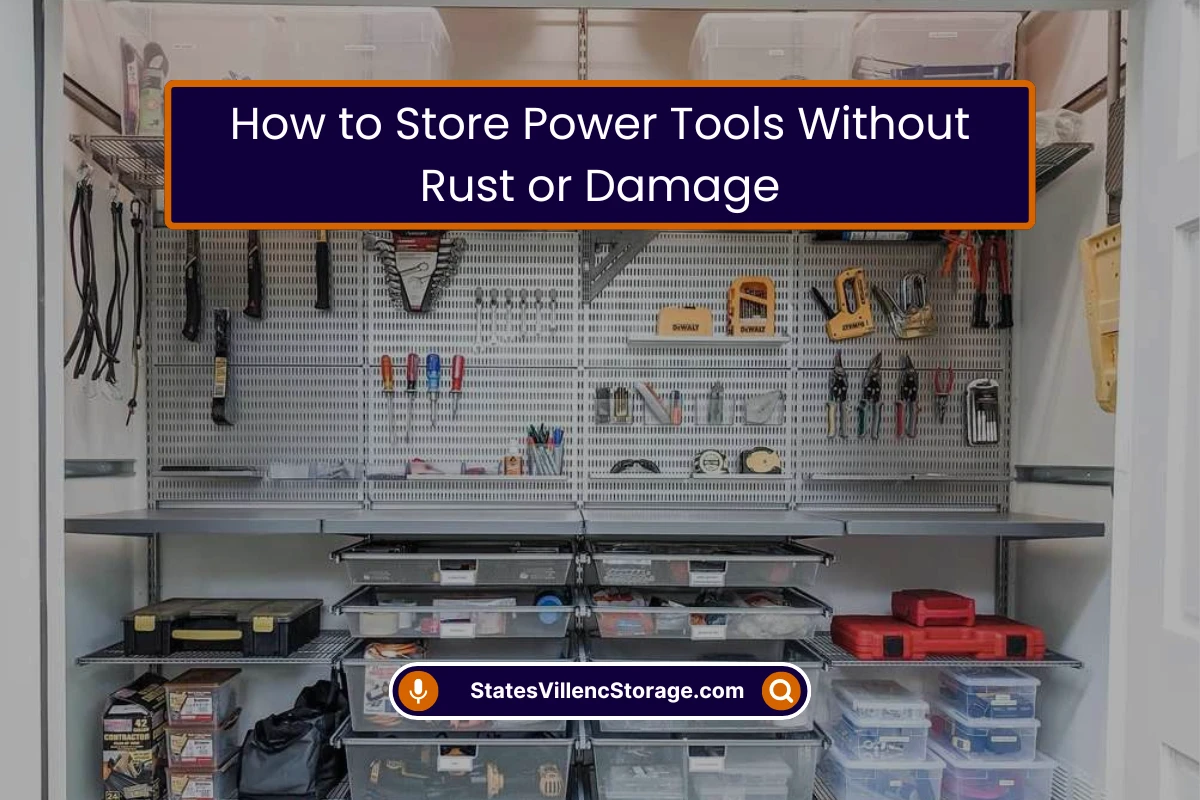
I ruined a $400 cordless nailer last spring.
Brand new. Bought it for a bathroom remodel. Fired maybe five hundred nails through it, cleaned it up, put it back in the case, slid it under my workbench. Thought I was being responsible.
Pulled it out three months later to help a friend frame a closet. Wouldn’t fire. LED light blinked red. Checked online. Apparently humidity had gotten into the motor windings and corroded something internal. Repair cost was almost as much as a new one.
I was pissed. Not at the tool. At myself. Because I knew better.
I just didn’t do better.
Why I’m Telling You This
I run a storage place. Every day, people bring in table saws, planers, drill presses, whole workshops on wheels. And every day, I see the exact same mistake.
People wait until their tools are already broken to think about where they keep them.
They’ll spend two hours researching which cordless impact driver has the most torque. They’ll watch seventeen YouTube videos on sharpening chisels. But the place where those tools will spend 95% of their life? That gets an afterthought. “Eh, I’ll just put it in the corner.”
That corner is a liar.
What Actually Happens In There
You know that feeling when you open a drawer and smell mustiness? Not wet, just… stale. That smell is moisture. You can’t see it, but your tools can feel it.
I had a guy bring in a cabinet saw once. Beautiful machine. Three horsepower, cast iron top, Biesemeyer fence. He kept it in his garage for eight years. Looked fine from ten feet away. But when I ran my finger along the edge of the table, it wasn’t smooth. It was rough. Felt like very fine sandpaper.
That was rust. Not the orange flaky kind. The kind that just takes the polish off and makes everything drag a little harder. His saw was dull before he even turned it on.
He said he never noticed. Why would he? He wasn’t running his hand across the table every day. He was parking his car next to it.
The Battery Thing Everyone Gets Wrong
Okay, this one actually bugs me.
You know how your drill battery dies and you think “well, it’s old, they don’t last forever”? That’s what they want you to think. But it’s not entirely true.
I talked to a Milwaukee rep at a job fair a couple years back. Asked him point blank: what kills batteries fastest. He didn’t say number of charge cycles. He didn’t say using high drain tools. He said heat and storage charge.
Heat: leaving batteries in a truck box in July. Or on a charger that keeps them hot. Or in a garage that bakes like an oven.
Storage charge: leaving them full for months at a time. Apparently lithium ions get stressed when they’re at 100% and just sitting there. Like a person holding their breath indefinitely.
He told me the ideal is 40-60% if you’re not using them for a while. Cool, dry place. Not the tool box in your uninsulated shed.
I’ve stored batteries that way for the past year. Haven’t lost one since. Coincidence? Maybe. But I don’t think so.
The Real Problem With Garages
I’m not here to trash your garage. Some garages are great. Heated, insulated, dry, organized. But most? Most are just… leftovers. The space that didn’t fit in the house.
They get the humidity from the dryer vent. The cold from the uninsulated door. The dirt from the driveway. The occasional mouse.
And your tools live there full time.
I used to store my router bits in a metal toolbox in the garage. Not rusty, just… sticky. They didn’t slide in and out smoothly anymore. Took me way too long to realize the temperature swings were making the lubricant in the slides gum up. Brought them inside, put them in a plastic ammo box in the closet. Smooth as butter now.
Should have figured that out five years ago.
Here’s What We Offer
We’re a storage place. Obviously I think you should rent from us. But not because I want your money. Because I genuinely hate seeing good equipment turn into junk.
We have climate controlled units. Not freezer cold, not oven hot. Just… stable. 68 degrees, give or take. Humidity held in check. No condensation cycles. No sweating concrete floors. No freeze-thaw.
I had a woodworker show me his unit last week. He’s got a Powermatic jointer in there, a bandsaw, a drum sander, about twenty grand worth of machinery. Said he used to keep them in his barn. Had to resurface the cast iron tables twice a year from rust pitting. Now? He pulls them out, they’re exactly how he left them.
That’s what we’re selling. Not square footage. Consistency.
Small Changes That Actually Help
You don’t need a storage unit to keep your tools alive longer. But you do need to change a few habits. Here’s what I’ve started doing that made a difference:
- Stopped storing tools on concrete: Even in a plastic case, even on a shelf, I try to keep an air gap. Concrete breathes. It pulls moisture from the ground. Put a 2×4 under your toolbox if nothing else.
- Take batteries out of tools: I know it’s convenient to leave them clicked in. I know the tool stands up nicer that way. But those little brass terminals corrode over time. Separating them breaks the circuit and stops micro-current drain. Takes two seconds.
- Loosen springs and belts: Any tool under tension when stored—miter saw springs, belt sander belts, bandsaw blades—I back it off. Tension stretches things. Stretched things don’t rebound.
- Wipe tools down before putting them away: Not a deep clean. Just a rag. Sweat from your hands has salt. Salt rusts steel. Thirty seconds of wiping saves hours of derusting later.
- Toss dessicant packs in my toolboxes: You know those little silica packets that come in shoe boxes? I save them. Throw a few in each tool case. When they get soft, I bake them in the oven at 200 degrees for an hour and reuse them.
The Question Nobody Asks
We spend all this time learning how to use tools. Bevel angles, feed rates, blade selection, dust collection. We treat skill like the only thing that matters. But skill doesn’t matter if the tool doesn’t work when you pick it up. A dull blade you can sharpen. A dead battery you can charge. A broken motor bearing? That’s a trip to the repair shop. Or the trash. I’m not saying you need to baby your equipment. Tools are meant to be used. Scratches happen. Dust happens. Wear happens.
But storage damage? That’s the one kind of damage you can completely prevent. Not reduce. Prevent.
You just have to decide that where your tools sleep matters as much as how they work.
So Here’s My Pitch
If your garage is full. If your basement sweats. If your shed leaks. If you’re stacking tool cases three high because there’s nowhere else to put them.
We have clean, dry, steady space. Drive-up access so you’re not carrying a lunchbox planer up three flights of stairs. Month to month, no weird contracts. You can move your gear in tomorrow and out whenever you need it.
I’m not going to pretend it’s the same as having a dedicated workshop at home. It’s not. But it’s better than watching your investment slowly degrade because there was nowhere better to put it.
And honestly? Sometimes just having the space—breathing room—makes the whole hobby more enjoyable. You’re not tripping over tools. You’re not losing bits in piles of clutter. You just… have a place for things.
Last Thing
I still think about that nailer sometimes. The one I killed through neglect. Stupid way to lose four hundred bucks.
I replaced it. Same model. This time I keep it in a case, in my living room closet, with a dessicant pack and the battery sitting next to it at half charge. My wife thinks I’m insane. Maybe I am.
But it works every single time I pull the trigger.
That’s all I wanted in the first place.










0 Comments