


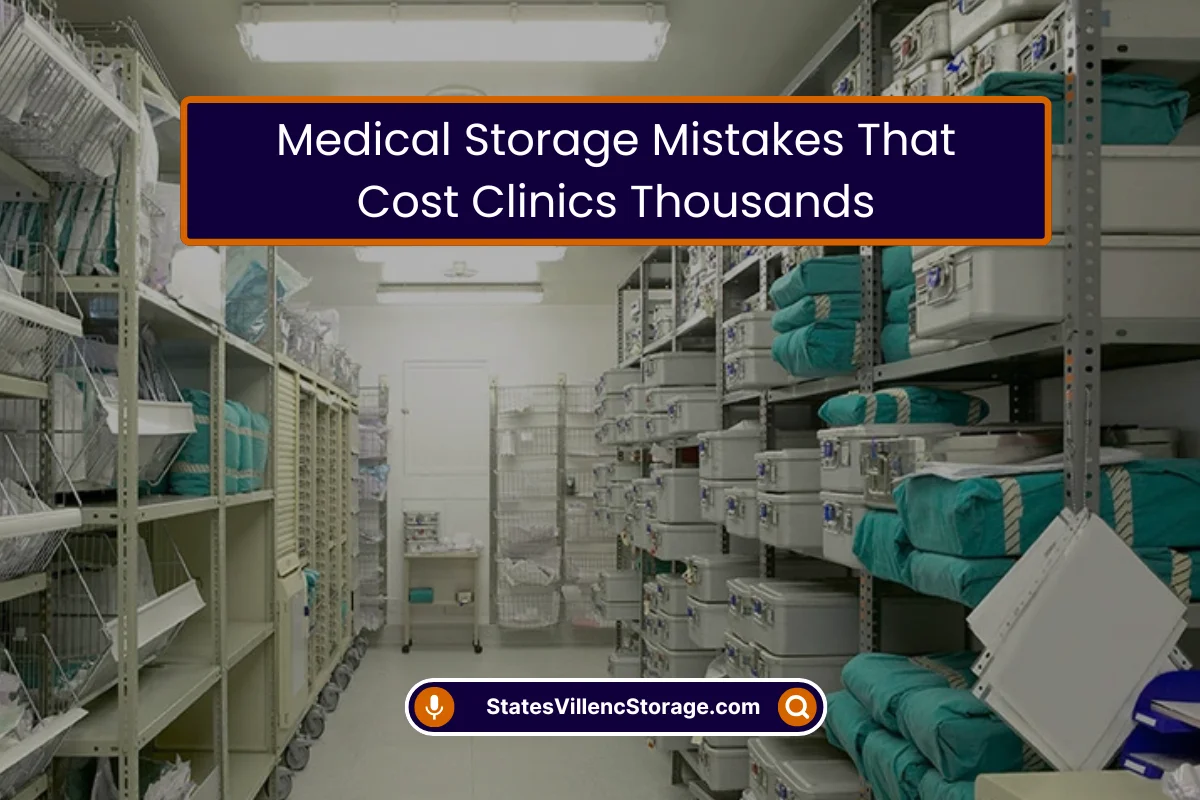
I was talking to a practice manager last month—we’ll call her Sarah. She runs a busy orthopedic clinic. She was telling me about the $4,000 ultrasound machine they “lost” for eight months. They found it eventually. It was in the back of a storage closet behind a bunch of old marketing banners from a health fair they did in 2023.
She laughed about it. But then she stopped laughing and said, “You know, I probably spent that much just in staff time looking for it before we gave up and borrowed one from our sister clinic.”
That stuck with me. Because Sarah is not alone. I see this every single day when I talk to clinic owners.
You are losing money on storage. You probably don’t see it on a line item in your P&L statement. It hides. It shows up as “miscellaneous supplies,” or “overtime hours,” or “equipment rental fees.” But it is real money. And it adds up to thousands a year.
Let me walk you through the specific ways this happens. I am willing to bet you are dealing with at least two of these right now.
You Are Paying Clinic Rent for Stuff That Should Be in a Garage
Think about what you pay per square foot.
If you are in a decent medical building, you are probably paying somewhere between $25 and $45 per square foot annually. Maybe more depending on your city.
Now look at your floor plan. How much of that space is dedicated to things that have nothing to do with seeing patients?
I walked into a dental practice last year. They had a whole operatory—a room designed for procedures—that they were using to store boxes of old patient models, a broken x-ray sensor they meant to send out for repair, and cases of bottled water for the staff.
That room should have been generating revenue. Instead, it was a very expensive closet.
If you have 200 square feet of your clinic dedicated to storage, and you are paying $30 per square foot, that is $6,000 a year you are spending just to hold stuff. Not to use it. Just to hold it.
You would never write a check for $6,000 to rent a closet. But that is exactly what you are doing.
The Expiration Date Cycle of Doom
This one drives me crazy because it is so avoidable, yet I see it everywhere.
You buy supplies in bulk to get the volume discount. Smart move. But then you put those supplies wherever there is an empty corner. Six months later, someone needs a specific suture or a dressing size. They cannot find it because the storage room looks like a game of Tetris gone wrong. So they order more. Overnight shipping. Premium price.
Meanwhile, the original boxes are sitting in the back. You find them six months after that. They expired four months ago.
I talked to a family practice that did an inventory cleanout last spring. They threw away over $3,500 worth of expired vaccines and supplies. The office manager told me, “If we had just known what we had, we would not have reordered half of this.”
It is not even just about the expired stuff. It is about the cash flow. You are double-buying. You are paying for the same supplies twice because you cannot see your first purchase.
Your Staff Is Doing Archaeology Instead of Medicine
How much time does your team spend looking for things?
Seriously. Ask your lead medical assistant tomorrow morning. Just ask. “How much time do you think you waste every day hunting for supplies?”
I have asked this question dozens of times. The answer is almost always between 15 and 30 minutes a day. Multiply that by five staff members. Multiply that by five days a week. You are losing an entire workday every single week just to people walking around opening cabinets.
That is not a small thing. That is a full salary worth of productivity you are paying for, but you are not getting any patient care out of it.
And here is the kicker—it kills morale. Nobody wants to feel like they are working in a storage unit. Your staff wants to feel professional. When they are climbing over boxes to get to the blood pressure cuffs, they feel like they are working in a chaotic mess. That contributes to burnout. And burnout leads to turnover. And turnover in a medical practice costs you a fortune in recruiting and training.
The HIPAA Risk You Are Probably Sitting On
I do not want to sound alarmist here. But I have to say this.
If you have old charts—even if you are fully electronic now—you have paper. You have consent forms. You have authorizations. You have old files that have to be retained for seven years or until the patient turns 21, depending on your state.
Where are those sitting?
If the answer is “in a hallway,” or “in a closet that does not lock,” or “stacked in the corner of the breakroom,” you have a problem.
It does not take a big breach to get a HIPAA fine. It takes one disgruntled person, one unannounced audit, or one lost file. The fines start in the tens of thousands. And that is before you factor in the legal fees and the headache of dealing with a breach notification.
You need those records. You have to keep them. But you do not need them sitting in your clinic, taking up your most expensive space, creating a security risk.
The Equipment That Goes on Vacation
Here is something I hear all the time: “I know we own one. I just do not know where it is.”
It happens with portable equipment. EKGs. Ultrasound wands. Procedure carts. Even wheelchairs.
Someone takes it to a satellite office. Or a traveling specialist uses it and leaves it in a room nobody checks. Or it gets pushed behind a shelving unit during a deep clean.
So when you need it, it is gone. You either waste an hour of staff time tearing the place apart, or you rent one. Or you buy another one.
I know a clinic that realized they had three portable suction units. They only ever used one. The other two were buried in different closets. That is hundreds of dollars of equipment sitting there, unusable, because nobody had a system.
What We Have Learned
We started offering storage to clinics because we kept hearing the same story over and over. “We don’t need more space. We need the right space.”
What we have found is that clinics do not need a bigger building. They do not need to pay more rent. They just need to separate their clinical space from their non-clinical storage.
You need the exam rooms, the procedure rooms, the patient areas. That is your business. But the archived charts? The backup inventory? The seasonal equipment? The marketing banners and the holiday decorations and the extra furniture? That stuff should not be sitting next to your patients.
When you move that stuff out, something changes. Suddenly your supply closet is actually usable. You can see what you have. You stop double-ordering. Your staff stops playing hide and seek. And you get back the square footage you were already paying for.
What I Would Do If I Were You
If I were running a clinic tomorrow, here is what I would do.
First, I would walk through every single storage space in the building. I would bring a notepad. I would write down everything that has not been touched in six months. I would mark what is clinical and what is just… stuff.
Second, I would calculate how much square footage that stuff is occupying. Multiply that by your rent per square foot. That is what you are paying annually to store things that are not generating revenue.
Third, I would look at your expired supplies from the last year. Add up that number. That is cash you literally threw in the dumpster.
Add those two numbers together. That is your baseline loss. And I have not even included the staff time or the equipment replacements yet.
For most clinics, that number is between $5,000 and $15,000 a year. Some are much higher.
The Fix
You do not need a renovation. You do not need to move to a bigger building. You just need to stop using your expensive clinical space as a warehouse.
We built our storage service exactly for this. We give you a clean, secure, climate-controlled place to put everything that does not need to be in your clinic. It costs a fraction of what you are paying for your current square footage. And it frees up your space so you can actually use the building you are already paying for.
You get to keep your bulk pricing on supplies. You get to keep your archived records secure and compliant. You get to stop tripping over boxes. And your staff gets to work in a place that feels like a real clinic instead of a storage facility with exam tables.
If that sounds like something that would make your life easier, let us know. We have worked with a lot of practices that thought they needed to expand their lease. They did not. They just needed a smarter place to put the stuff that was getting in their way.











0 Comments